
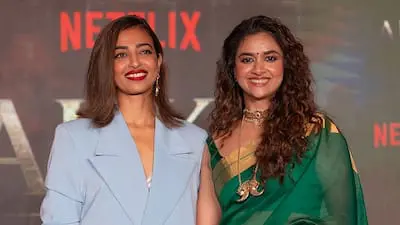
Keerthy Suresh has responded to Radhika Apte’s controversial remarks about playing a character who marries her maternal uncle in a Telugu film. Keerthy stood by the custom, saying she would never let down her culture.
What Radhika Apte Said
The controversy began during the promotions of the Netflix series Akka, in which Radhika Apte and Keerthy Suresh star together. In an interview, Radhika recalled the most difficult role of her career, a Telugu film in which her character had to marry her maternal uncle. She said she “hated everything” about the role and called the situation patriarchal.
Radhika didn’t name the film, but it is widely believed to be Boyapati Srinu’s Legend with Nandamuri Balakrishna. Her remarks drew a sharp reaction from Telugu audiences on social media.
Keerthy’s Response
When asked about Radhika’s comments, Keerthy Suresh explained that she hadn’t understood the remark at first.
“I didn’t understand what she meant when she said she had to marry her uncle in a film. Only later did I realise that she was referring to the culture,” Keerthy said.
She made her stand clear. “With all due respect, I will never let down our culture. I can only explain it to them because they don’t know about it. I cannot prove to them that this is our culture.”
Murai Maaman in South India
The custom Keerthy is referring to is known as Murai Maaman in Tamil, where marriage between a girl and her maternal uncle is a traditional practice in some communities. It is also seen in parts of Andhra Pradesh and Telangana, and it has been shown in many Tamil and Telugu films over the years.
“I don’t know about Karnataka, but I was just sharing information that this culture exists in Tamil Nadu and Andhra Pradesh. Kerala doesn’t have this culture,” Keerthy added.
A Calm Clarification
Keerthy’s response has been widely welcomed by Telugu and Tamil audiences. Instead of adding to the controversy, she explained the cultural context behind the custom that Radhika’s remark had missed.